
A "golden thread" connects North Africa and East Asia: Sino-French joint exhibition of gold apparel.
The magnificent garments adorned with gold thread embroidery, the glittering gold ornaments, and the gold hairpins create a tapestry of Silk Road gold thread clothing culture.
The special exhibition "Golden Threads: The Fashion of Gold Clothing from North Africa to East Asia," jointly organized by the Chengdu Museum and the Musée du Quai Branly, one of France's four national museums, recently opened to the public at the Chengdu Museum. The exhibition brings together over 200 pieces/sets of exquisite gold-woven textiles from 14 cultural and museum institutions in China and France, telling the story of these magnificent textiles from multiple perspectives along the geographical contours of the Silk Road.
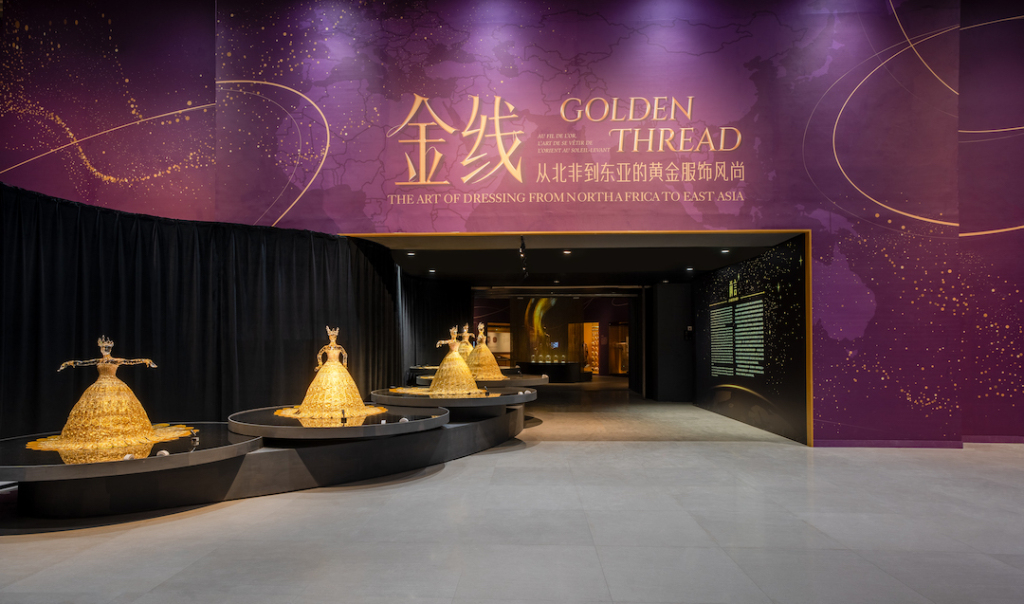
Exhibition Hall Entrance
A "golden thread" woven into the memory of clothing culture
As the first stop of its global tour and the only stop in China, the exhibition uses "gold thread" as its theme, bringing together more than 200 pieces/sets of brocade treasures from seven French cultural institutions, including the National Museum of Quai Branly, the National Museum of Archaeology, the National Museum of Natural History, and the Convergence Museum, as well as precious collections from eight domestic cultural institutions, including the China National Silk Museum, the Liaoning Provincial Museum, the Gansu Provincial Museum, and the Qinghai Provincial Institute of Cultural Relics and Archaeology.
Exhibition site
Exhibition site
Golden thread is a perfect combination of nature and human craftsmanship: Madagascar's golden-rimmed spider silk, Mediterranean sea snail golden thread refined from the deep sea, Cambodia's natural golden silkworm silk, and Lurex thread made with modern technology... In this special exhibition, "golden thread" captures a richer and more magical language of nature to communicate with civilization, and presents the gold-weaving culture of different regions in a magnificent way.
Speaking about the origins of the exhibition, Hana Al-Bana-Cidiac, curator at the Musée du Quai Branly in France, said, “My intention in creating this exhibition was not simply to present a collection of beautiful garments. Initially, I wanted to explore why humans used gold in clothing, to uncover more of the stories behind it, rather than just seeing its superficial splendor. Many people may think that gold originates from Earth, but after research, I discovered that it actually comes from the universe, a gift from the stars to Earth.” Hana Al-Bana-Cidiac added that after discovering natural gold, humans went through a very long process from processing it into gold products to creating gold thread for textiles.
Sea oyster (juvenile specimen), from the Gulf of Gabes, Tunisia, 1982, collection of the French National Museum of Natural History.
Upon entering the exhibition hall, following the geographical trajectory of the Silk Road, the exhibition is divided into five sections: "Sunset Glow: Bright Costumes of the Maghreb," "Sand Sea and Starry Sky: Gold-embroidered Art of the Middle East," "The Charm of Arabian Weaving: The Aesthetics of Faith in the Arabian Peninsula," "The Fragrance of Silk and Brocade: The Splendid Garments of India and Southeast Asia," and "Gilded Warp and Weft: Golden Memories of the Eastern Silk Country." Through multiple perspectives, including gold-embroidered techniques, costume art, and aesthetic origins, the exhibition weaves together a magnificent picture of the continuous and thriving culture of gold-embroidered costumes along the Silk Road.
Owl-shaped gold ornament, Spring and Autumn Period (770-476 BC), collection of Gansu Provincial Museum.
A gold hairpin shaped like a flowering tree, dating to the Former Yan Dynasty (337-370 AD). Unearthed from M2, Tiancaogou, Xiyingzi Township, Chaoyang County, Chaoyang City, Liaoning Province. Collection of Liaoning Provincial Institute of Cultural Relics and Archaeology.
A gold hairpin shaped like a flowering tree, dating from the Former Yan Dynasty (337-370 AD), unearthed from the Lama Cave Cemetery in Sijiaban Village, Nanbajia Township, Beipiao City, Chaoyang City, Liaoning Province. Collection of the Liaoning Provincial Institute of Cultural Relics and Archaeology.
In the Maghreb, gold thread was a symbol of Ottoman power. The wedding robes of Kaftan were embroidered with gold thread on their purple bodies.
Algerian Clothing, Section 2, Unit 1, Exhibition Hall
Algerian Clothing, Section 2, Unit 1, Exhibition Hall
The first section of the exhibition hall features Tunisian clothing.
In the Middle East, gold thread blends Eastern and Western fashion. Egyptian wedding gowns of the 18th and 19th centuries were based on European Western-style dresses, adorned with Ottoman-style embroidery, exuding luxury and splendor.
The second section of the exhibition hall features Egyptian costumes.
The second section of the exhibition hall features Turkish clothing.
On the Arabian Peninsula, wide robes are decorated with gold and silver embroidery and sequins, and the floral patterns and geometric designs outlined in gold thread embody the unique religious aesthetics of Arabia.
Exhibition Hall Map, Section 3: The Art of Covering
In Southeast Asia, as an important hub of the Maritime Silk Road, many countries such as India, Cambodia, and Laos have a tradition of using gold thread. The shimmering Indian saris, the vibrant Indonesian sarongs, and the Cambodian drapery all gleam with the brilliance of gold thread.
The fourth section of the exhibition hall features Cambodian clothing.
Exhibition Hall Map, Unit 4: Indonesian Clothing
In China, the "Silk Kingdom of the East," gold thread was a symbol of etiquette and decorum on clothing. The Tang Dynasty's gold-embroidered brocade belt with tortoise shell pattern was exquisitely crafted; the Yuan Dynasty's fragments of gold-embroidered running deer were elegant and refined; the Ming Dynasty's bright red silk embroidered robe with unicorn and phoenix patterns over the shoulders was dignified and luxurious; and the Qing Dynasty's yellow dragon robe with flowing cloud and bat patterns exuded imperial majesty, profoundly interpreting the essence of civilization that "clothing carries the way."
Gold-woven brocade belt with tortoise shell pattern, Tang Dynasty (618-907 AD), unearthed from the Reshui Cemetery, Dulan City, Qinghai Province, collection of Qinghai Provincial Institute of Cultural Relics and Archaeology.
Yellow-ground dragon robe with cloud and bat motifs, Qing Dynasty (1636-1912), collection of the China National Silk Museum.
When Gold Meets Chinese Silk
China domesticated wild silkworms around 5,000 years ago and invented techniques such as silk reeling and weaving, making silk one of the most iconic cultural symbols of Chinese civilization. "The exhibition particularly highlights the textile-related connections between China, the Middle East, and Europe in recent centuries, a history that naturally evokes the Silk Road," said Immanuel Kassahrou, director of the Quai Branly Museum.
The red silk embroidered robe with qilin and phoenix patterns draped over the shoulders, worn by women during the Ming Dynasty (1368-1644), is from the collection of the Shandong Museum.
Along the ancient Silk Road, civilizations from different regions shone like stars in the sky. While maintaining their unique cultural essence, they blossomed into a magnificent chapter of mutual inspiration and harmonious coexistence. Chinese artisans, the "Kingdom of Clothing," combined Eastern silk with gold-embellishing techniques, constantly innovating: using the Western Regions' gold thread weaving techniques to create intricately structured, shimmering gold-embroidered brocade belts with tortoise-shell patterns; inspired by the Western Regions' gold thread weaving techniques, they created three-dimensional gold-embroidered dragon-patterned quilts; Nanjing Yunjin, inheriting the achievements of the "Nashishi" gold-embroidered brocade technique popular in Europe during the Yuan Dynasty, combined it with its representative brocade weaving techniques to create "Zhuanghua Jinjin," a uniquely Eastern-style weaving technique, a model of "East meets West" in clothing.
Wedding attire, 19th century, from the National Museum of Québécois, Cairo, France.
The "Golden Thread" exhibition in Chengdu is not merely a simple traveling exhibition, but a reinterpretation. The exhibition incorporates important artifacts from the Chengdu Museum's textile collection, and the textiles on loan from other Chinese museums further enrich the presentation. For example, visitors can see gold earrings unearthed at the Huoshaogou site in Yumen, Gansu Province. This site yielded gold earrings and gold nose cups dating back approximately 4,000-3,800 years, representing early Chinese gold artifacts. There is also a three-dimensional gold-embroidered quilt with dragon patterns, inspired by the gold thread weaving techniques of the Western Regions; and a half-sleeved garment from the Chengdu Museum's collection, featuring a combination of Shu brocade and Sogdian brocade… "These domestic exhibits solve the problem of localized representation in the exhibition, fully showcasing China as the most important representative of East Asia, highlighting its gold thread technology and the techniques for blending silk and gold thread," said Huang Xiaofeng, Deputy Director and Chief Curator of the Chengdu Museum.
According to Ji Xiaofen, curator of the China National Silk Museum, human use of gold, silk thread, including jade and lacquerware, was actually influenced by sun worship and the pursuit of light. "Silk thread itself carries a natural sheen." Ji Xiaofen also mentioned that gold artifacts related to textiles unearthed in China can be traced back to the Shang and Zhou dynasties. Gold foil from the Shang dynasty has been unearthed in the Central Plains, while gold foil and gold thread from the Eastern Zhou dynasty have been unearthed in Shandong. "From a clothing perspective, the gold-threaded robes of the Han dynasty were made by stringing together gold thread and jade pieces. Furthermore, the robes used to worship Buddha unearthed in the underground palace of Famen Temple already featured gold embroidery."
The robe on display dates from around 1950 and is from the collection of the National Museum of Québécois, France, in Saudi Arabia.
The exhibition also features internationally renowned haute couture artist Guo Pei and the Lesage Embroidery Workshop, presenting a dialogue that bridges Chinese and Western aesthetics, showcasing the evolution and integration of Silk Road gold thread art across millennia and thousands of miles.
Works by internationally renowned haute couture artist Guo Pei
“This exhibition is not only cultural, but also artistic, and cross-disciplinary. It allows visitors to feel the traces of history and the atmosphere of fashion, a dialogue between history and modernity,” said Huang Xiaofeng, Deputy Director and Chief Curator of the Chengdu Museum. A thousand years ago, Shu brocade and camel bells wove a splendid trade tapestry across Sichuan. This collaboration with the Musée du Quai Branly in France not only deepens the exchange of collections and academic interaction between the two museums, but also represents a brilliant convergence of Chinese and French cultures under the guidance of the Silk Road spirit, jointly exploring a new chapter of mutual learning and sharing among civilizations.
The exhibition will run until March 29, 2026.
Filed under

Suzhou Museum’s “beauties in the north,” first look
On site at Suzhou Museum—a new exhibition bringing northern beauties into Jiangnan galleries.

Archaeology Shanghai opens under a museum skylight
Shanghai Museum East Hall’s permanent “Archaeology Shanghai” gallery—skylight as the room’s signature.

What are the highlights of the Shanghai Museum's East Hall "Archaeology Shanghai" permanent exhibition?
The pig pottery sculptures from the Majiabang culture, which prove that China had domesticated pigs as early as 6,000 years ago, the ivory scepter from the Lian...