
Ryukyu king’s edict on view: expanding “lost arts”
A royal Ryukyu edict at Lushun Museum—why scholars say the kingdom’s lost arts need a wider map.
the Dalian Lushun Museum recently exhibited the "Imperial Edict of the King of Ryukyu," attracting the attention of many visitors. This edict, issued in the second year of the Chongzhen reign of the Ming Dynasty (1629), is written in neat regular script and contains the imperial decree of the Ming emperor conferring the title of "King of Zhongshan of Ryukyu" upon the crown prince of Ryukyu, Sho Feng.
Han Xingfang, former deputy director of the Lushun Museum, who has long been engaged in the research of related cultural relics and documents, said that this imperial edict reveals the important historical fact that Ryukyu was once a tributary state of China. Xie Bizhen, director of the Institute of Sino-Ryukyu Relations at Fujian Normal University, has been committed to Ryukyu studies Recently, a discipline that was recently selected as a national "unique academic discipline." He believes that Ryukyu studies are not only an academic necessity, but also because Ryukyu has important significance in the geopolitical landscape of the Pacific.
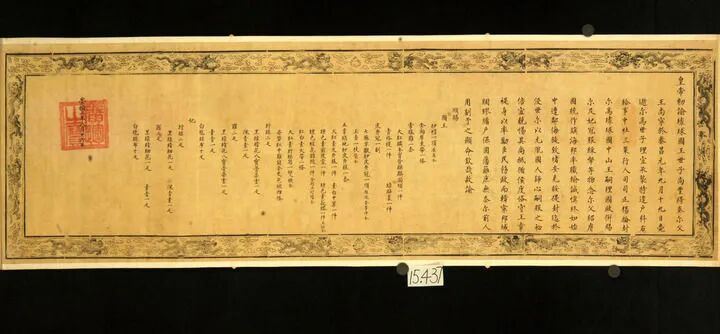
"Imperial Edict to the King of Ryukyu"
Historically, the Ryukyu Kingdom was located between Taiwan and Kyushu, Japan, stretching 1,000 kilometers and covering a total area of 3,600 square kilometers. Due to its unique geographical location, it was known as a transit point for trade between Northeast and Southeast Asia, boasting thriving trade and earning the title of "Bridge of All Nations."
Currently, Japan has de facto administrative power over the Ryukyu Islands and has established Okinawa Prefecture, but some scholars believe that the sovereignty issue of the Ryukyu Islands has not been fully resolved from the perspective of international law.
Cultural relics bear witness to history: the tributary system that lasted for five hundred years
On the yellow paper, golden cloud and dragon patterns surround the design, and the square seal with the inscription "Guangyun Zhi Bao" in red ink is clearly visible. This is an imperial edict issued by the Ming Dynasty emperor to the King of Ryukyu in 1629. It is quietly displayed in a showcase at the Lushun Museum in Dalian, telling the story of East Asia hundreds of years ago.
The original "Imperial Edict to the King of Ryukyu" is currently stored in the Lushun Museum's warehouse; the one on display is a replica. The edict reads: "The Emperor hereby issues this edict to Crown Prince Sho Feng of Ryukyu: Your father, King Sho Ning, passed away on the 19th day of the ninth month of the first year of the Taichang era. As the Crown Prince, you are the rightful heir. Therefore, the Emperor hereby dispatches Du Sanze, Right Attendant of the Ministry of Revenue, and Yang Lun, Director of the Court of Imperial Sacrifices, to confer upon you the title of King of Zhongshan of Ryukyu, to succeed you in governing the country, and to bestow upon you and your consort crowns, robes, colorful coins, and other gifts."
"Remembering that your father inherited the throne and served as the guardian of the coastal region, he diligently performed his duties with utmost sincerity, remaining cautious to the end. He faced neighboring aggression but quickly brought peace and stability, achieving his goal and remaining so until his death. As the heir apparent, you are the people's lord. At the beginning of your reign, you should be even more diligent and cautious. You should respectfully follow the lord's conduct, strictly adhere to the royal decrees, lead by example to encourage your subjects, govern diligently to maintain peace and stability in the country, strengthen the defenses, and protect the borders, so as not to disgrace your predecessors. Thus, you will fulfill my solemn mandate. Therefore, this edict is issued. Bestowing gifts..." The edict then detailed the items and quantities to be bestowed.
This text records the actual situation of the tributary relationship between China and Ryukyu during the Ming and Qing dynasties, where a new king needed to be formally conferred by the Chinese emperor upon his accession to the throne.
Han Xingfang, former deputy director of the Lushun Museum who has long been engaged in related research, said in an interview that the phrase "suffering humiliation from neighboring countries" mentioned in the imperial edict refers to the invasion of Ryukyu by Japan with 3,000 troops in the 40th year of the Wanli Emperor's reign (1612 AD), during which King Shang Ning was captured. The History of Ming records: "Ryukyu defended itself against powerful neighbors and maintained continuous tribute. In the 40th year, Japan indeed sent 3,000 strong troops into the country, captured its king, seized its royal artifacts, and plundered extensively before leaving."
However, even after the Japanese invasion, Ryukyu remained loyal to the Ming Dynasty of China. Han Xingfang emphasized that after King Shang Ning was released, he "sent envoys to pay tribute again," and in 1612, when Japan planned to invade Taiwan, he promptly reported to the Ming Dynasty, which is sufficient to demonstrate his respect and loyalty to the Ming Dynasty.
According to Han Xingfang's research, the Ming Dynasty conferred titles upon Ryukyu a total of 15 times, with the conferment during the Chongzhen era being the last one.
Exhibition of "Imperial Edict of the King of Ryukyu"
In the eleventh year of the Shunzhi reign of the Qing Dynasty (1654 AD), King Shoji of Ryukyu sent envoys to Beijing, returning "two old edicts, one imperial decree, and a gilded silver seal," and requesting the issuance of a new imperial decree and seal. Thus, this imperial decree issued during the Chongzhen reign of the Ming Dynasty was returned after many twists and turns. Thereafter, the Qing Dynasty largely followed the Ming system, continuing its investiture of Ryukyu.
In 1372, Emperor Zhu Yuanzhang of the Ming Dynasty dispatched Yang Zai to persuade Ryukyu to accept the investiture. From then on, every Ryukyu king was officially recognized by Chinese envoys.
In the early Ming Dynasty, a maritime ban was implemented, with the court stipulating that "Ningbo should connect with Japan, Fujian with Ryukyu, and Guangdong with Southeast Asian countries." For over 500 years, exchanges with Ryukyu primarily took place in Fujian. Through this tributary relationship, Ryukyu quickly rose to become a trading hub renowned as a "bridge between nations," experiencing rapid socio-economic development.
A Portuguese traveler described in his travelogue that the Ryukyuans dressed extravagantly and were even more wealthy than the Fujianese merchants.
Hu Huanyong's Strategic Vision of Ryukyu and Its Contemporary Repercussions
Hu Huanyong, a key founder of modern Chinese human geography, is best known for proposing the "Hu Huanyong Line," a geographical dividing line for China's population. Less known is his profound expertise in political geography and geostrategic research. In 1945, Hu Huanyong compiled and published "Taiwan and Ryukyu," systematically expounding his core stance on the Ryukyu issue. Hu Huanyong first rigorously argued the rationality and legitimacy of China's claim to sovereignty over Ryukyu from historical and legal perspectives. In "Taiwan and Ryukyu," he meticulously examined history, pointing out: "Since the Sui and Tang dynasties, Ryukyu has been part of our territory. During the Ming and Qing dynasties, it was successively granted investiture, as evidenced by numerous historical records."
From a geographical perspective, Hu Huanyong's analysis of the strategic value of the Ryukyu Islands is particularly insightful: "The Ryukyu Islands are located between the Japanese archipelago and Taiwan," forming a "natural barrier along the eastern coast of China." He clearly pointed out that "if China does not wish to build a navy and venture into the Pacific Ocean, then so be it; otherwise, the Ryukyu Islands are indeed an outer barrier to China's eastern maritime borders."
This assessment profoundly reveals the close connection between Ryukyu and China's maritime development and national security.
Xie Bizhen, director of the Institute of Sino-Ryukyu Relations at Fujian Normal University, has been dedicated to Ryukyu studies Recently, a discipline recently selected as a national "unique academic" subject. Xie believes that Ryukyu studies are not merely an academic necessity, as Ryukyu holds significant importance in the geopolitical landscape of the Pacific. He stated, "Ancient Ryukyu (present-day Okinawa) held a special position; the ancients referred to it as the 'throat of the Pacific.' The Chinese geographer Hu Huanyong stated that 'without Ryukyu, one cannot be considered a Pacific nation.'"
Xie Bizhen's research revealed that Ryukyu (Okinawa) still retains many Chinese cultural heritages. "Historically, thirty-six families of Fujianese people migrated to Ryukyu, making indelible contributions to the development of Ryukyu society. Their migration brought advanced production techniques and culture, pioneering many aspects of Ryukyu society. In terms of religious beliefs, Feng Shui is prevalent, and the belief in Shigandan (a type of stone offering) exists; in terms of folk customs, there are ancestor worship, stove god worship, and Confucius worship; local music, dance, and drama all contain elements of Chinese culture." During his visit to Okinawa, he observed that the bustling markets there were vastly different from the orderly markets in mainland Japan, resembling instead those in Fuzhou. "You can even see young people pounding glutinous rice with stone mortars and wooden mallets to make rice cakes, exactly like the traditional method in Fuzhou," Xie Bizhen remarked. He added that many Okinawan folk songs actually originated from Fujian music brought by "floating refugees," and "some ancient tunes that are now difficult to find in Fujian can still be heard in Okinawan melodies."
However, looking back at history, Ryukyu's fate has been fraught with hardship.
According to historical records, in 1609, the Shimazu clan of Satsuma invaded Ryukyu. In March 1879, Matsuda Michiyuki, the Japanese "Ryukyu Administrator," led a fully armed "reception army" to land at Naha Port in Ryukyu, advancing directly towards Shuri Castle, the capital of Ryukyu. The Japanese army forcibly entered the royal palace, and Matsuda Michiyuki issued a cold-blooded expulsion order to King Shō Tai: surrender the official registers (registers of household registration and land ownership), vacate the royal palace within a specified period, and Ryukyu was immediately renamed Okinawa Prefecture. The last king of the Ryukyu Kingdom, Shō Tai, tearfully bid farewell to the ancestral temple where his ancestors were enshrined, left the royal city, and boarded a ship bound for Tokyo. In 1901, Shō Tai died in Tokyo, never able to return to his homeland.
Shotae, the last king of Ryukyu
In 1945, the brutal Battle of Okinawa devastated the Ryukyu Islands, turning them into a wasteland. Xie Bizhen's research points out that during the Cairo Conference in 1943, when discussing the post-war treatment of Japan, Roosevelt proposed that the Ryukyu Islands belong to China, a suggestion rejected by the Chiang Kai-shek government. After Japan's defeat in 1945, the Ryukyu Islands were occupied by the US military. After 27 years of occupation, the Ryukyu Islands were again annexed by defeated Japan.
In 1879, Matsuda Michiyuki led his military police to occupy Shuri Castle in Ryukyu. (Source: Global Times)
Xie Bizhen believes that Ryukyu studies not only have academic value but also significant practical implications. For example, on the territorial issue, Sino-Ryukyu historical research provides conclusive evidence proving that the Diaoyu Islands belong to China.
The plaque reading "Land of Courtesy" in Ryukyu historical buildings
Xie Bizhen believes that Ryukyu studies urgently need to expand in depth and breadth, transforming from a "lost field" to a "prominent field." Today, Ryukyu studies have evolved from simply tracing historical documents to an interdisciplinary system integrating geopolitics, cultural heritage, and social identity. "New research directions in Ryukyu studies are expanding with the deepening of archival digitization and international collaboration. The strategic value of Ryukyu in the maritime century, the implications of Sino-Ryukyu exchanges for the construction of an East Asian community, and the changing identity of the Ryukyu people all await in-depth exploration. The complexity of the Ryukyu issue determines that its research will inevitably transcend the academic realm, becoming a key to understanding East Asia's past, present, and future," Xie Bizhen stated in his article on Ryukyu studies.
(Some information in this article is based on the Lushun Museum, Xinhua News Agency, and relevant Ryukyu research literature.)
Filed under

The project of "Chinese Art Literature Collection", which can be called "the Complete Library of Four Branches of Literature in the Arts", has been launched
Recently, my country has made great achievements in the compilation and publication of ancient books, and important achievements in the field of art docu...

The tomb of a king of the ancient state of the Western Zhou Dynasty, which is not recorded in historical records, has recently been confirmed.
The Peng State, a vassal state during the Western Zhou Dynasty, is completely undocumented in historical documents. Its existence, culture, and history have onl...

Eating melons across dynasties in Chinese folk art
Great Heat and melons—cooling fruit as a long motif in folk art and excavated relics.