
Yinxu, Sanxingdui... "Archaeology China" major project has made new progress
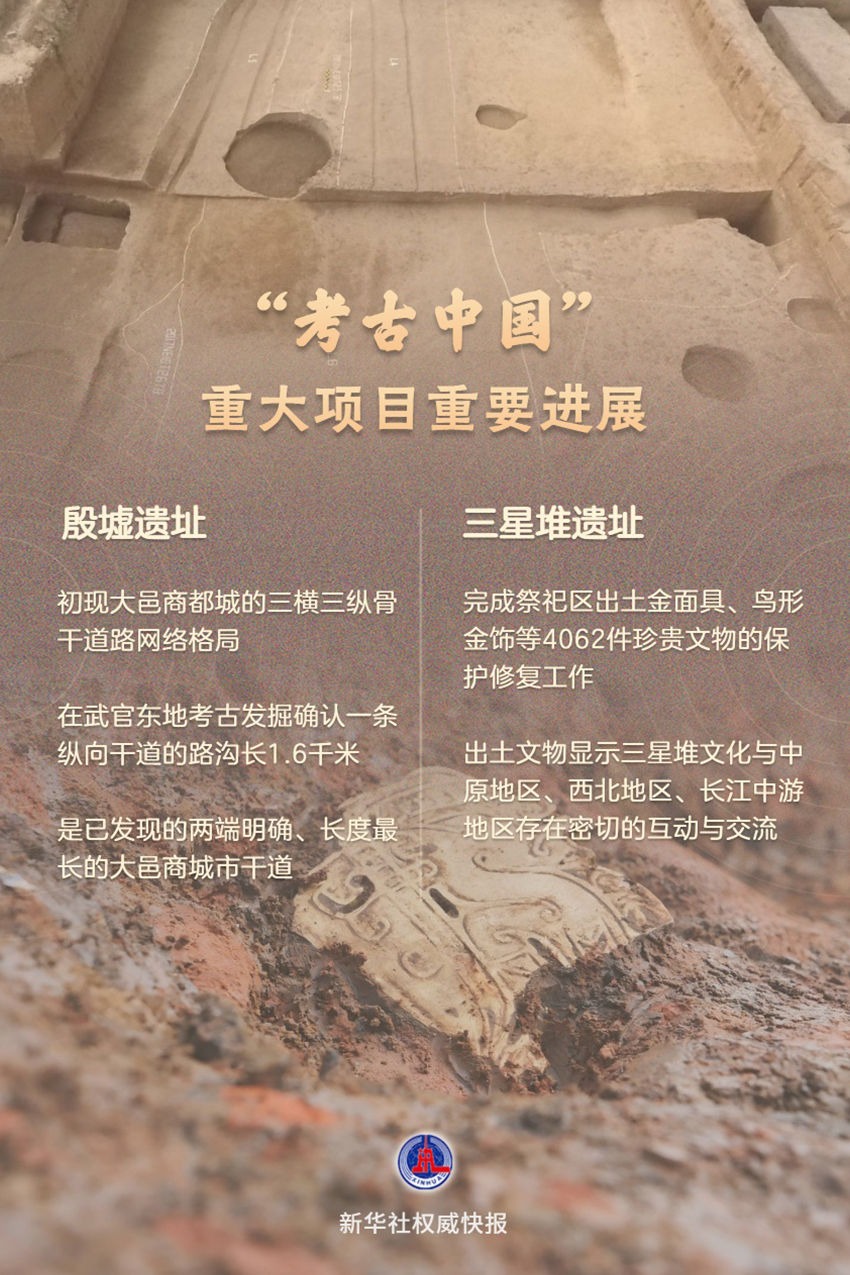
On December 26, the State Administration of Cultural Heritage held a working meeting on important progress of the major project "Archaeology China", reporting the latest archaeological findings at the Yinxu site in Anyang City, Henan Province, the Sanxingdui site in Guanghan City, Sichuan Province, the Erlitou site in Luoyang City, Henan Province, and the Zhongcun Cemetery in Xiyang County, Shanxi Province.
At the Yin Ruins site, the three horizontal and three vertical trunk road network of Dayi Shang capital city first emerged in the area on the north bank of the Huan River, and many roads and road ditches were discovered. Archaeological excavations at Wuguan East confirmed that the road ditch of a longitudinal main road L3 was 1.6 kilometers long, with dense ruts on the road surface, with a spacing of 1.2 meters between each group. This is the longest Dayi Shang city main road discovered with clear ends.
The Sichuan Provincial Institute of Cultural Relics and Archaeology has joined hands with 16 institutions to promote the protection and restoration of Sanxingdui unearthed cultural relics, completing the protection and restoration of 4,062 precious cultural relics such as gold masks and bird-shaped gold ornaments unearthed in the sacrificial area, and conducting research on the casting process and origin of bronze ware. The unearthed cultural relics show that Sanxingdui culture had close interactions and exchanges with the Central Plains, Northwest China, and the middle reaches of the Yangtze River.
The Gucheng Village site is located on the north bank of the Luo River to the north of the Erlitou site. Three trenches and one rammed earth wall from the Erlitou culture period have been discovered. Experts speculate that they are most likely the trenches and city walls outside the Erlitou capital, providing important clues for exploring the layout of the Erlitou capital.
The Zhongcun Cemetery is the largest and highest-level cemetery discovered in the eastern part of the Loess Plateau during the Xia and Shang dynasties. Its burial customs have strong local characteristics and are also influenced by the Erlitou Culture, Xiaqiyuan Culture, etc., showing a diverse cultural landscape and filling the gap in the Xia and Shang dynasty archaeology on the western foothills of Taihang Mountain.
Filed under

Kyoto exhibits Japan's prehistoric civilization, including adorable clay figurines from the Jomon period
A dialogue of civilizations spanning thousands of years recently unfolded in Kyoto, Japan. The Paper has learned that a special exhibition titled "The Worl...

Western Zhou oracle bones, Sui and Tang dynasty murals and other Ningxia Guyuan cultural relics are on display at the Shanghai Museum
"A lone smoke rises straight in the desert, the sun sets over the long river. I meet a scout at Xiaoguan, and he tells me that the Protector General is at ...

From the most exquisite to the most beautiful and rare rare books, a glimpse of the ancient books of the Song and Yuan Dynasties collected by Shangbo
"Jade Chu Liufang: Song and Yuan Ancient Books Collection of Shanghai Museum" is the first large-scale special exhibition of ancient books since the e...